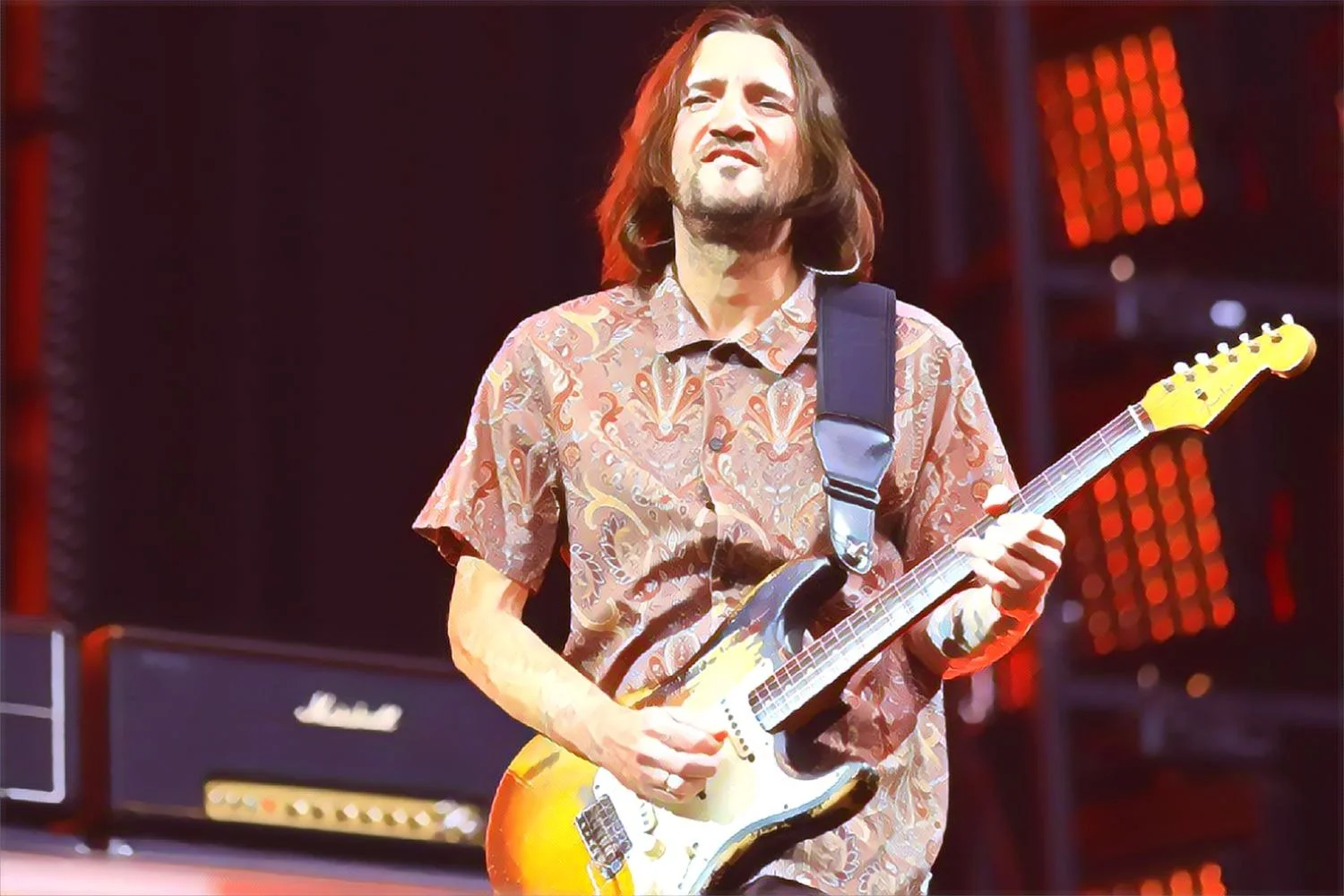
"The idea of someone considering themselves responsible for a piece of music is ridiculous - we're only acting into the laws of nature that have, you know, that have given us the possibilities that we're exploring with the intelligence we've been given. You have something like the frequency spectrum from low to high - that's what we're working with. That's here whether we're here or not... it exists as part of the structure of physical reality, and our brains are learning to interact with it through learning to use an instrument, or, through using our voice in a certain way... The possibilities are presented in this kind of this invisible silent way."
John Frusciante
I used to write a music blog called The B-Side Conversations. I still have a few pieces on a hard drive, and this is one of them, where I shared my love of John Frusciante. John is most famous as the guitarist in the Red Hot Chili Peppers, but this piece is about the beauty of his solo work, so I thought I'd share it here. I originally wrote it in 2018, before John rejoined the band and before some of his other solo projects came out. I hope you enjoy it.
The aim of these "geek posts" was always to write about what an artist means to me, in the hope that it inspires somebody else to explore their art. And to the artist: if you do the (very) unlikely thing of finding this, please know that I never judge others' work. I simply try to describe how it has connected with my soul. Thank you for your art.
It is hard to describe how much John Frusciante's music means to me. My first real experience of John was listening to Scar Tissue on loop when I was fifteen, on a trip to the USA that I was lucky enough to be invited on by my friend Luke Brown's family.
I had, of course, heard of the Red Hot Chili Peppers, because Give It Away and Under the Bridge were never off UK radio. But I was only eight when that album came out in 1991, so I knew little more than those two songs, one funk rock and one cinematic (at that age I was rather more focused on the Teenage Mutant Hero Turtles).
By the time Scar Tissue was released in 1999, I was old enough to be conscious of music, and it moved my soul in a way I still find hard to adequately articulate. The guitar part that opens the song, written and played by John, was the most moving I had ever heard. The melody was so graceful, and the words were instantly memorable. Even more powerfully, the video let me understand this band exactly as they were, despite my knowing nothing about them.
Thanks to US television, Scar Tissue was played at least a dozen times a day, and I would dissolve into the music and the imagery on every spin, because it was endlessly cathartic. You could feel this tribe of four men, each clearly scarred as an individual, yet together at peace as a brotherhood.
I had no idea then that the meaning I felt was the director's absolute intention, Stéphane Sednaoui's (who also shot the video for Give It Away, for what it's worth). His metaphors and symbols captured the very essence of the band at that moment in time. John had just returned after six years away, following an aphotic period in which he almost lost himself to drug addiction. That song and that video were his return, and they caught it all so poetically. And so I fell in love. (As an amusing side note, I have read that John doesn't actually drive, even though the video opens with him at the wheel.)
I don't want to dwell here on John's famous (and occasionally infamous) work with one of my all-time favourite bands. I want to write about his solo work, because this side of his art has been so overlooked, to the detriment of the music world. As my dear friend Ibs once said, "If John Frusciante hadn't been part of the Chilis, his solo work would be critically acclaimed." I couldn't agree more.
But before I get there, given that I fell in love with John's musicianship through that remarkable band, like most people, it would be remiss of me not to share one of my favourite Chili’s songs, which also happens to contain my most treasured live performance and guitar solo of his.
Don't Forget Me is an incredible composition and, in my view, one of the finest songs that best captures the brilliance of this group. It has the formidable rhythm section of Chad and Flea. Flea plays what is basically a guitar part that doubles as a hip-hop bass loop, and Chad plays a drum beat that is ferocious and yet melodic. Anthony is in the most gracious form, completely at one with the music. And then there is John Frusciante, the most distinctive lead guitarist of his generation, playing in a way that feels like a gift from beyond this world.
Now, to John sans the Red Hot Chili Peppers.
John's genius as an artist (or his ability to channel a higher power, which is how I would rather put it) is not easily captured. So, to avoid getting too conceptual, I'll pick out two things that at least begin to describe his contribution. The first is the sheer range of genres in which he has written, recorded, released and, indeed, mastered music. The second is his prolific spell between February 2004 and February 2005, which, perhaps above all else, puts him on a pedestal of his own.
Having been integral to writing two enormous albums with the Chilis (Californication in 1999 and By the Way in 2002), John released six albums and one EP in the twelve months from February 2004. Most were solo records. One was a full collaboration with Josh Klinghoffer, and one was made by a supergroup, in the truest sense of the word (though I imagine John would humbly reject it), with Josh and Joe Lally of Fugazi. They called the group Ataxia. A second Ataxia album was recorded in the same sessions but not released until 2007, and there was a ninth project too: five songs on the soundtrack album to the film The Brown Bunny, released that same spring, which John had written before the film was made.
That moment was so remarkable that it's hard to know where to begin, so let me start with one of the most beautiful songs I have ever heard: The Past Recedes.
One of the top comments underneath it on YouTube, from BentheBoss992, says how the song made me feel better than any words I can find: "I randomly decided to search 'John Frusciante' on YouTube and accidentally found one of the greatest things I've ever heard." Bravo, BentheBoss992!
Those twelve months
The range of genres in John's solo work is astonishing. Here is my attempt to map where each record sits. It isn't a perfect scale, since John creates in several genres at once, but I have done my best. More to the point, I am not that familiar with electronic music, so my placement of John's later records could be way off (as, frankly, it could be with the others). I hope it helps you find the music that sits closest to your own taste.
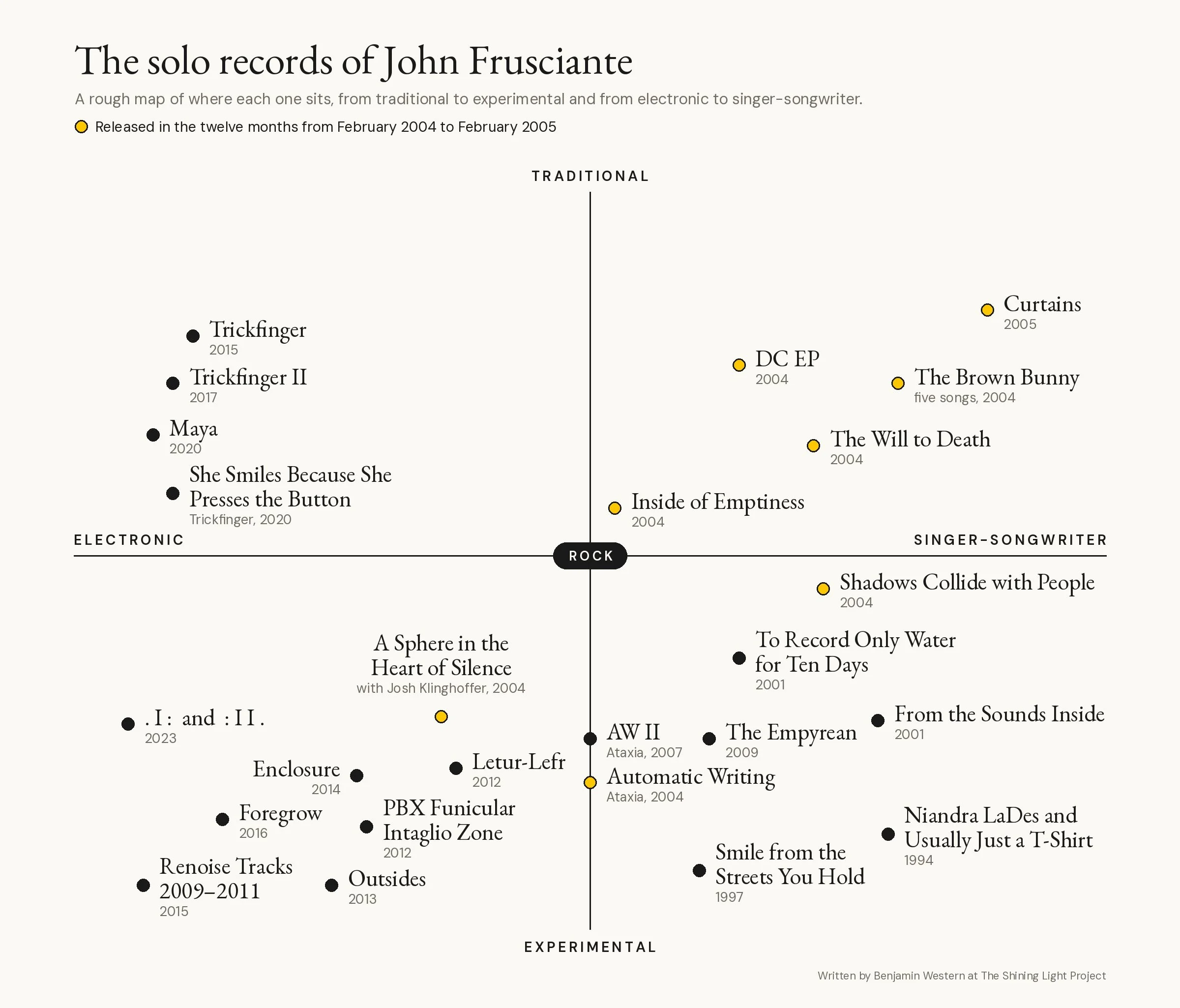
Now let me put February 2004 to February 2005 into context.
For most artists, seven projects in twelve years would be a respectable run, and better than average. In almost any genre, a release every two years is about as frequent as it gets. Seven projects in seven years is very rare outside hip-hop and dance music (kudos and respect to Mark Kozelek, one of the few exceptions). Releasing seven in twelve months is close to unheard of.
Yet volume is beside the point. What really astonishes me is that the records were all great, which leaves me with no superlatives to spare.
Each one was built on a different idea, a different texture and different instruments. For me, the jewels in the crown, and the place I would recommend anyone begins, are Curtains and Ataxia's Automatic Writing. They are two of the most contrasting records (with A Sphere in the Heart of Silence being the most sui generis).
Curtains
Of Curtains, John said: "It was just me sitting on a pillow, on my living room floor, with my back leaning against the couch." It is John at his most serene and gentle, and the result is one of the most beautiful albums I have ever heard.
There are baroque, pop, and rock melodies; acoustic guitar and classic John guitar leads; and voices set against each other in unexpected octaves (though for John fans, this is precisely the kind of authenticity and surprise we seek out and have grown used to).
On first listen, a song like The Real feels like a modern take on something medieval or baroque. It isn't instantly accessible (the best music rarely is). The double bass plods along in time with the plucked acoustic guitar, as calm as it is endearing. Yet as the song waltzes on, there is fine melody upon fine melody, until, at one minute and twenty-one seconds, a divine, crying guitar begins to weep. Then a subtle snare joins that majestic rhythm section, and by the time the synth arrives, along with the harmony (John with John) and those adoring, somehow jovial lyrics, the song has become the most beautiful outward meditation. As it finishes on John's trademark lead guitar, heavy with delay and reverb, I'm hooked. I had been hooked, on loop, for about fourteen years when I wrote this, and I still am. It is the kind of record that needs time, but it rewards you with a lifelong gift.
So, on the one hand, John wrote one of the most elegant acoustic albums I have ever heard. And in those same twelve months, he was also in Ataxia with Josh Klinghoffer and Joe Lally, making a song like Dust. Rather than describe it, I will ask of you what was asked of me when my dear friend Ibs introduced me to Ataxia. He sent me this song with a specific request: "Listen to this sitting in the dark, and turn the volume to the maximum." He asked, I obliged, and my head nearly blew off. Please, I beg you, do the same. You will thank me (and therefore Ibs) for it.
Ataxia
Joe Lally described how the project worked. "The songs would be initiated by me settling into a bass line," he said. While he was finding it, Josh would be playing, and John would start doing something, and within a few minutes they kept going. There was no thought of an end product. The goal was to see how quickly they could work music into place, and it was only ever meant to be a show that nobody would hear again. Ataxia played two shows, both at the Knitting Factory in Los Angeles, on 2 and 3 February 2004, and then disbanded.
The result is one of the finest experimental rock records I have ever heard. In John's words: "If you like me cause you saw me live, and I was beating the f*** out of my guitar, then this record - which is a collaboration with Josh Klinghoffer and Joe Lally - will give you what you're looking for. If you don't care about song structure, and you want powerful music with f***ed-up guitar-playing and songs that are really long, this record is the one."
When I wrote this, the most-listened-to Ataxia song on Spotify, The Sides, had only 670,000 plays, and I wish more people had heard this music. The Sides is my favourite song on the record, and comfortably one of the five songs I have listened to most in my entire life.
The above is the only live recording of those two gigs. It's the kind of gig I would have sold everything I owned to be at. What a moment in time, what a record, what a band. Shockingly, given the deep cult following it later gathered, I read in an interview with Joe Lally (which I can no longer find) that they didn't think anyone would be that interested in the project; otherwise, they would have done more with it. I have to admire just how good John, Josh and Joe are, to be so unaware of their own genius.
Yet Curtains and Ataxia show only two sides of John's work in this period, because each project had a different purpose and even a different way of being recorded.
Shadows Collide with People
Shadows Collide with People is perhaps the boldest of them, certainly in having the widest range of tones and genres, taking in folk, electronic and alt-rock. It was John's most expensive album to that point, costing around $150,000 to make, and a real departure from his earlier records, which had been made at home on multitrack recorders. "I was sick and tired," he said, "of people dismissing my records as being f***ed-up and unprofessional."
I have always found that quote a little disheartening, because it is the raw, vulnerable and therefore authentic nature of John's solo work that makes it so loved by those who know it. There is a place for polish, of course, and the investment in the engineering and production of Shadows shines, making for a divine record. But I also love music that may sound as though it was recorded in a cell on a four-track, when the character and heart of the song are worth every technical flaw (this record by F.J. McMahon is a lovely example). And for the real geeks: Shadows is the only one of John's solo albums that Chad Smith plays on, and Flea turns up too, playing double bass on the closing track.
The Will to Death
The Will to Death, on the other hand, is a more archetypal rock record. After the long and costly making of Shadows, John recorded quickly and sparely, allowing himself a maximum of two takes per track (yes, two). He said he intended it to be "the opposite of Shadows Collide with People", with very few backing vocals because there had been so many on Shadows, and he added that he always has to have a new idea for each album.
DC EP
Then there is the short, four-song DC EP. What stood out to me on first listen was that the guitars didn't sound like John, whose style is so recognisable: most often a Fender Strat, drenched in reverb and delay. And as it turned out, they weren't his guitars. "These songs were written while I was on tour for By the Way," he said. "I was listening to the Velvet Underground a lot." He was used to producing his own records, and here he left that in the hands of Fugazi's Ian MacKaye, "using equipment that wasn't mine, playing instruments that weren't mine". The guitars were recorded through one of Guy Picciotto's Marshall JCM 800 amplifiers, the very one pictured on the artwork of Fugazi's Red Medicine, and for the solo on Dissolve John borrowed Picciotto's Les Paul Junior.
A Sphere in the Heart of Silence
Josh Klinghoffer is a whole other artist, and one who deserves a piece like this of his own. He was John's main collaborator in this period (and would eventually take John's place in the Red Hot Chili Peppers when John left for the second time, in 2009). He is a masterful musician, to say the least, and appears on drums, electronics, bass, guitar, vocals and more across these records. This one, though, was a full collaboration between the two, and the result is wild, diverse and gorgeous. In John's words: "It's electronic music, but much more raw." They recorded it, he said, in the same out-of-control way as Inside of Emptiness, only with electronic instruments, with techno elements and punk-rock screaming over the top. "It's only a seven-song album, but it's, like, thirty-eight minutes long."
Of particular beauty is Communique, which John described as one of those songs that is as long as it took to record. In other words, they did one take and a serene masterpiece was born. I love this album most of all because it is two people I deeply admire in a space that was clearly euphoric for them, in their own understated way. This is my favourite song from it, and do watch John's dancing in the live version (so cool).
Inside of Emptiness
Of the records from this period, this is the most punk and the rawest rock, and yet it is still incredibly melodic. John called it powerful in a gentle way, with a soothing quality, where even the soft things have a heaviness to them. "The song 'Scratches' is emotionally heavy to me," he said, "even though it's not distorted guitars and bashing drums." And then, as only John could put it: "There's a lot of spontaneity and recklessness and not giving a f***."
John Frusciante’s humility
I have always believed there are artists so unique, and so beautifully articulate, that it is impossible to fathom their existence. For me, John Frusciante is such a person. There is a reason he was the first person I wrote about on the old blog: of all the artists I admire, his is the soul I resonate with the most. In the interview below, which I have watched several times, you could not witness a more humble, profound and gentle being. I beg you to find the time to watch it all, because it offers such wonderful insight into the mind of someone so gifted.
One of the many things John says that I treasure, and which captures the essence of him, is this, about Hollywood and the music industry:
"It's the big lie that's been perpetrated ever since the star-making machine of Hollywood started. They get this idea that the physical image and the name of the person is responsible for the creation of what they do, but that's not what creates it. What creates it is the imagination."
He goes on to say that what puts one person in the right place, at the right time, to create what they need to create is a complex structure of the mind, the soul and the nervous system, along with all the unknown things in the subconscious, which can be shaped as much by terrible things as by good ones. And then he says this:
"A person can be abused and put down for their entire life and for whatever reason their will to live, their love for music, their feeling for music and all the f***ed up things that have happened to them all combine to make perfection."
There is so much depth in that. We are often encouraged to see artists as godlike visions, and to believe that their creations spring from some innate genius. John gently turns all of that away. He denies his own genius, suggesting it comes from something far beyond ourselves.
We live in an age with an ever-increasing desire to rationalise almost everything, and to break things down into explainable parts. This has been going on since the Enlightenment in the eighteenth century, and back then it was an understandable (and in many ways needed) rejection of the Church's dogma. But we now live in a Western world where fewer and fewer people are open to the possibility of a non-rational explanation of how things are, or how they could be.
What's my point? Well, it isn't about religion at all. It's that I believe music should be a place where artists explore the precise opposite of a rational world, and offer us the vivid and wild corners of their own. Artists like John Frusciante are rare. His art explores the unexplainable, and it is endlessly fascinating.
I believe John Frusciante was part of one of the biggest-selling and most successful groups of all time, and wrote some of the finest songs ever written, not because he wanted the money or the fame, but because he didn't. I believe he is so deeply aware that music, his art, comes from a place far beyond our physical form that setting out to be the biggest would run against his very nature. Music isn't something to be designed for an agenda. It is to be formed from what a higher power channels through us. This perhaps explains why John was happy to spend one five-year period mostly just painting.
The way he speaks about creating music in the interview above is so beautiful. He often (understandably) stumbles to find the words to explain his philosophy and his understanding of his art. I may be painting myself as an overzealous sycophant of a fan here, but I can't help feeling that when John speaks, so much is going on in there that turning his thoughts into a cohesive sentence is almost impossible.
Younger John
Contrasting the interview above with the video below fascinates me on two levels. On one, the younger John could not seem more different from the elder. On the other, they are, for me anyway, absolutely the same, because his energy is ingenuity wrapped up in a vulnerability that I feel sits at the very centre of him, in a spiritual sense.
I can perhaps sum up my admiration like this. John is beyond any normal level of humility because he believes he is merely part of a complex system far beyond his (and our) power, and even our understanding, and he is continuously trying not just to make sense of it but to create something meaningful and lasting from it. You only have to look at the sheer range of his discography to grasp the scale of his ambition to keep exploring and learning. It takes great fortitude and courage to keep venturing into new territory like that, and he does it with such humility in both these videos.
That clip makes me laugh, and it fills me with admiration, because not only does John have such a youthful spirit, but he also helped write one of the defining albums of the nineties, Blood Sugar Sex Magik, at the age of twenty-one, and it included Under the Bridge.
The story of that song shows Rick Rubin's genius, and it includes the joy of John's mum singing on the outro. During the making of the album, Rubin was flicking through Anthony Kiedis's notebook when he found a poem called Under the Bridge, and he urged Anthony to show it to the band. Anthony was reluctant, feeling it was too emotional and not the Chili Peppers' style, but he sang it to John and Chad, who got up, walked over to their instruments and began finding the beat and the chords to go with it. John chose the chords of the introduction to balance the sadness of the words. "I thought if the lyrics are really sad like that," he said, "I should write some chords that are happier." And when Rubin felt the grand ending needed a crowd of voices, John invited his mother, Gail, and her friends from the choir she sang in.
It would be remiss of me not to include the song now, wouldn't it? I chose the clip from when John returned to the band for the second time in 2019, after leaving in 2009. Props to the sound engineer in the studio; the sound is incredible.
John's (mostly) unknown masterpiece, The Empyrean
By now, John fans might be perplexed that I haven't yet mentioned his masterpiece, The Empyrean. The question is where to begin with this album, so let's start with an astonishing song, Central.
I read that John had recorded the album on and off between December 2006 and March 2008, and even knowing his desire to make unique, experimental music, it took me by surprise. By the third listen I came to believe it was perhaps his most astonishing record, and by the tenth I realised it was not only his most complete project but also his most ambitious, complex and bold to date.
John has never seemed to aim for record sales, and having been in one of the biggest-selling bands in the world, he hardly needs to. Yet I can't help finding it a little heartbreaking that The Empyrean peaked at number 151 on the US Billboard 200 and number 105 on the UK Albums Chart. When you unravel this album and try to understand its lyrics, it is breathtaking.
The artwork is a photograph of prints arranged into a collage. In the upper left, there are green-leaved trees and layered images of mountains; in the lower left, there are roots and half-transparent fallen leaves, all of which have been read as a nod to the Tree of Life. That sits well with what John wrote about the album at the time: "We are all reaching up in our own way and so even when we choose concrete things as the object of our desire, I feel that they are only symbols and that the real object of our desire is the creative force inherent in everything."
Josh Klinghoffer is pictured lying next to a skull, joined by a rope or string to a winged, angelic figure of John, which speaks of death and rebirth. With songs called God and Heaven on the album, some have seen God and Jesus in the two figures, and others have seen Dante's Satan in John's many wings and heads. A spiral staircase climbs from where the dead figure rests towards a palace above the clouds, the highest point in heaven. And yet, as John wrote, the figure "eventually realises that the highest point in heaven is a potential inside him, and that no thing is any different than anything else". He comes to see that confusion and pain have been as much the cause of what made his life meaningful as the things he mistook for pure goodness.
The songs tell that story too. In John's telling, the main character goes through extreme loneliness and at times thinks he can only merge with this creative force by dying. In the eighth song, a kind of death takes place, which might be an actual death or might be a shedding of the unnecessary parts of the personality, and it results in a rebirth, in which he finds himself filled with wonderment at life.
This album, along with Ataxia and Curtains, is the one I revisit most, and when I do, it stays on loop all day. Each time it gives you more. There are so many nuances, and such vivid explorations of realms beyond ourselves. For me, of all John's guitar-based solo work, it is the album that best captures the sheer depth and imagination of the artist, and I only hope young people pick it up and just be with it.
Humble John, again, on other bands
Before I get to the last part of John's story, I would like to share a worthy interlude: John speaking about other bands. There is a moment at 3:58 in the video where he gets annoyed at being asked about his own band, which, for me, shows his humility about his work and how open he is about the ways other artists helped him. That was one of my goals in writing about music at all: to encourage young people to immerse themselves in the music of the greats as a way to inspire their own.
I also find his perspective so authentic and truthful. It's okay not to connect with every record, and to say why some work does or doesn't reach you. John says, for example, that he didn't like Nirvana's Nevermind that much because "I wasn't into punk for the masses", and he goes on: "For me, the album that really got me was In Utero - I love the intensity of it, the realness of it... it didn't sound like a producer's idea." (Which, as a side note, gives huge props to that album's producer, Steve Albini, a man with no ego about such things. I wrote a piece on Steve Albini here if you were interested).
The way John speaks about R.E.M. is so heartfelt and inspiring. "I pretty much had no friends and their music made me feel like I had a friend," he says. "I will always be indebted to them." He describes being so close to the edge at that time, and losing touch with the world to such a degree that it didn't seem there was any place left for him in it. Listening to their music, he says, felt like having a friend there, and he is very grateful for it.
The vulnerabilities of art
I was always in awe of the late, great Robin Williams. There was such depth to him. I once read that on the set of One Hour Photo, where he played a very dark, obsessive character, he couldn't help being the showman between scenes and kept making people laugh. The video below captures, poignantly, the reality of having the privilege, but also the burden, of being an artist.
I share it because it speaks so loudly of how tough it can be to be human, and even more so when your life depends on creative output. When I become overwhelmed by the sadness of the world losing Robin Williams, I think of artists like John. John came very close to death when he became addicted to heroin after the rise of the Red Hot Chili Peppers. And so I often wonder whether his laying down of the guitar (an astonishing thing to do when you are one of the greatest guitarists there has ever been) and his move to making only electronic music came both from a need to grow as a creative person and, perhaps, from a need to protect himself. Maybe I am reading too much into this, and perhaps it's really not my place to say such a thing. But from the artists I know, to stop growing is to die, creatively speaking, and that is a dangerous place to be.
If anything here touches on something you are carrying yourself, please do talk to someone. In the UK and Ireland you can call Samaritans, free, at any time of the day or night, on 116 123.
Even if I am totally wrong, what is certain is how much respect I have for John for pursuing a whole new art, and for continuing to push himself when he has no need to for the sake of legacy or money. I only wish his electronic work were more widely reviewed and heard.
I have to say that I am still very new to electronic music, so I will reserve comment on what John's electronic records mean to me. But I certainly thank him for introducing me to a whole set of sub-genres that I am now learning about because of him.
To close
I'm sorry to disappoint anyone who was expecting more about the Chilis here. That is for another day. This was about John and his much-overlooked solo work.
To close, I turn to one of the ancient writers I adore most, Cicero, who drew so deeply on the Stoics. He thought of our lives as works of art. He believed that we are limited by the materials available to us and yet, despite our personal limitations, able to create wondrous effects, so that the orderly beauty of one person's life might be a small-scale version of the orderly beauty of the universe.
I am drawn to Cicero because he resisted dogma, and because he held such wonder at the interconnectedness of human beings with one another and with the universe that encompasses us. As I hope you have seen throughout this piece, John Frusciante reflects that philosophy so poignantly. And I believe that in a world becoming ever more abrupt, fast-paced and transactional, John's art speaks to something truly wondrous.
I hope you have enjoyed reading about this beautiful man. I wrote it in the hope of inspiring people to spend time with artists who make their art for its own sake. I hope you discover something you love in his astonishing body of work, and that you spread the gospel to the kids. And if there's something I've missed or got wrong, please get in touch. I'd love to hear from you.
Thank you for reading. Take care of yourself and others.
Much love,
Benjamin
If John's story has left you wondering what your own gift might be, that is what our Living With Purpose course is for. You can find out more here.